Blog
Knitting journal: paper or digital?
Paper or digital knitting journal? What each does best, what to write in it, and how to switch without copying everything out again.
·
A knitting journal keeps track of every project you make: the pattern, the yarn, the needles, where you're up to and what you changed along the way. A paper journal is hard to beat for the joy of writing things down and sketching your charts. A digital one keeps everything in one place and goes wherever you go. And more often than not, the best answer is a bit of both.
Ask any knitter or crocheter, and the same scenes come up: a journal started and then forgotten, notes scribbled on the back of a pattern, and that row you just can't find again after a break.
Everything below works for crochet too: just swap "needles" for "hook", and "rows" for "rows and rounds".
What to write in a knitting journal
A good knitting journal holds everything you'll need to pick a project back up after a break, or make it again one day. Here's what's most useful to note down:
- The pattern: its name, the designer, the size you chose and where it came from (book, magazine, PDF).
- The yarn: brand, colorway, dye lot, how many skeins you bought and how many you actually used.
- The needles or hook: type and size.
- Your gauge: stitches and rows per 10 cm (4 in), and which needles you used.
- Your changes: longer sleeves, a decrease moved, a simplified motif.
- Where you're up to: the piece you're working on (back, left sleeve…) and the row.
- Dates: when you started, paused and finished.
- Photos, or a snip of yarn and the ball band.
You don't have to fill in everything every time. If you only note two things, make it the yarn and the needles: they're what you'll go looking for months later.
Paper knitting journals: the good and the not-so-good
What paper does best
A paper journal has a charm nothing else quite matches. No screen, just your handwriting, and before long it becomes a real keepsake of everything you've made.
Above all, it's still the best tool for sketching: a colorwork chart, a cable motif, a sweater schematic with its measurements. On graph paper, it's quick and natural. And you can staple in a swatch or tape in a ball band, which no app will ever do.
Where it falls short
The limits show up once your projects start piling up:
- One journal per project, or one for everything? The first way, they end up scattered. The second, finding anything means flipping through every page.
- You can't search it. "Which yarn did I use for last year's hat?" turns into a detective story.
- It's not always with you when you need it, like at the yarn shop, when you want to check what's already in your stash.
- Everything else lives somewhere else: your row counter, your yarn stash, the needles you own.
Choosing and keeping a paper journal
If you're sticking with paper, a few habits make all the difference:
- Go for graph paper pages: handy for charts and notes alike.
- Give each project a two-page spread: the fixed info on the left (pattern, yarn, needles), your progress on the right.
- Keep an index on the first pages, with the page number of each project.
- Add a pocket at the back for ball bands and small swatches.
Digital knitting journals: the good and the not-so-good
What changes
A digital journal brings together what, on paper, lives in different places: your projects, your patterns, your yarn stash, your needles and hooks. It fits in your phone, so it's with you everywhere, yarn shop included.
It also does what paper can't: a row counter built into each project, and filters to find "all my mohair yarns" or "my paused projects" in two seconds.
The downsides
Let's be honest: it's one more screen, and you need to get into the habit of noting things as you go. And for sketching a chart or a schematic, a pencil still feels much nicer than a finger on a phone.
Paper or digital: side by side
| Paper journal | Digital journal | |
|---|---|---|
| Joy of writing, keepsake | ✓ | ✗ |
| Sketching a chart or schematic | ✓ | Less handy |
| Finding old info | Flip through pages | A few seconds |
| Row counter | Separate | Built into the project |
| Yarn stash and needles | Separate | All in one place |
| Always with you | Not always | On your phone |
| Cost | The price of a notebook | Often free to start |
Why not both?
Lots of knitters and crocheters use both, and it's often the most comfortable balance: paper for the joy of it and for charts, digital for finding everything.
Going digital without copying everything out
The fear of re-entering everything is often what holds people back. You don't have to do it all at once:
- Start with your projects in progress, and only those.
- Add your yarns as you go, when you use them or buy new ones.
- Only bring over the essentials from your paper notes: the yarn, the needles, the row you're on. The rest can stay in your journal.
- Leave your finished projects on paper, or add them later, at your own pace.
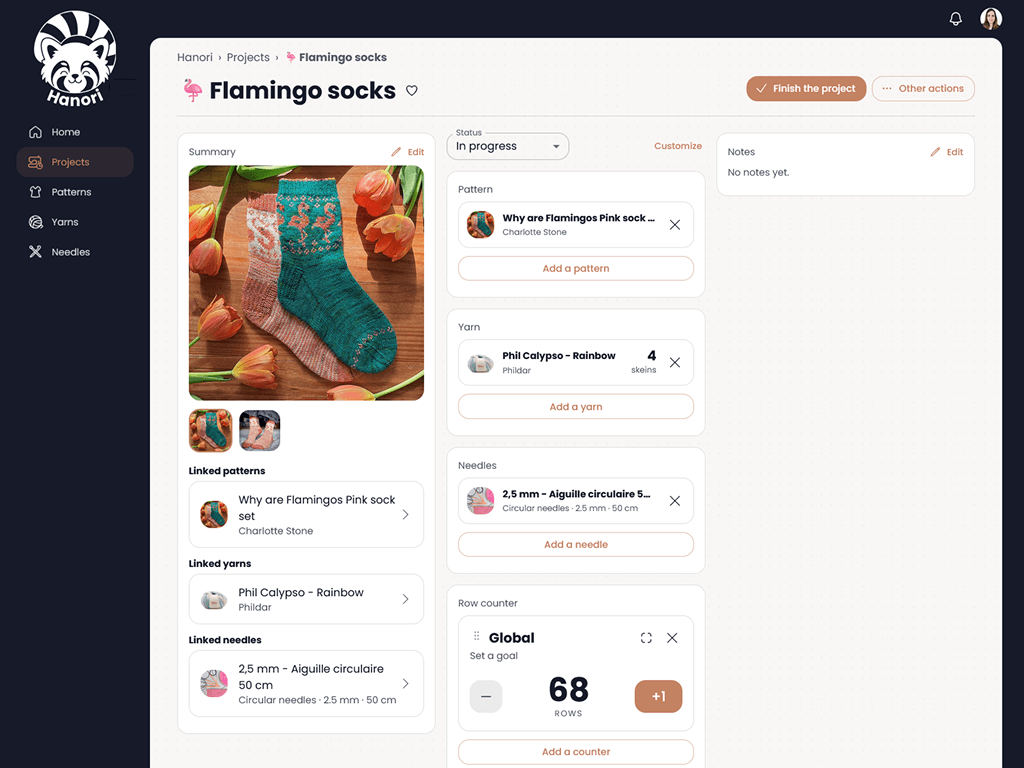
That's exactly why Kevin and I created Hanori: a digital knitting & crochet notebook that's simple by default. Each project has its own page, with a status, notes and a photo of the finished piece. You only add more if you want to, with modules: the pattern, the yarns (the skeins are then set aside in your stash), the needles and a row counter.
Frequently asked questions
Should I keep one journal per project or one for everything?
One journal for all your projects is easier to keep at hand, as long as you keep an index at the front. One journal per project quickly gets hard to track once you have several on the go. Digitally, the question doesn't come up: each project has its own page, and everything's in one place.
Is there a free digital knitting journal?
Yes. Hanori is free to start, with no time limit: the free plan is a real notebook, with unlimited yarns, patterns, needles and hooks, and up to 5 projects, ideas included. Premium (€4.99/month or €39.99/year) goes further on organization, for those who need it.
Does a knitting journal work for crochet too?
Yes, the same details matter: the pattern, the yarn, the hook size, your gauge and where you're up to. In crochet, you often count rounds rather than rows, and a journal, paper or digital, saves you counting again.
What should I do with my old paper journals?
Keep them: they're keepsakes, and they're still perfect for your charts. To go digital, start with your projects in progress and only bring over the essentials: the yarn, the needles and where you're up to.
The best journal is the one you open
Paper, digital or both: there's no single right answer. The best knitting journal is the one you actually open, at every row, every break, every new skein.
So, are you a spiral-notebook person, a phone-next-to-your-knitting person, or a bit of both? Tell me on Instagram, @hanori.app 🧶