Blog
How to organize your yarn stash (and stop buying doubles)
Take stock of your yarn stash, know what's set aside for each project and stop buying yarn you already have. A simple method for knitters and crocheters.
Organizing your yarn stash means taking stock of it, sorting it, storing it, then keeping it up to date every time you buy yarn or finish a project. It's what stops you buying yarn you already own, and it helps you see what you could knit or crochet with what's already on hand. You don't need to give up a whole weekend: a simple method is enough, and it fits in six steps.
Buying a yarn you already had at home. Has that ever happened to you? You're far from the only knitter or crocheter it's happened to, and it's completely normal: a stash grows fast. A crush at the yarn shop, leftovers from a sweater, three skeins bought "for later"… Having a stash isn't the problem. Not knowing what's in it is.
Step 1: Get everything out and declutter
The first step is to gather everything in one place. Really everything: the tub under the bed, the basket in the living room, the bottom of your project bags, even the yarn from paused projects.
Use the moment to declutter, guilt-free. Keep what you love and what you actually want to use. As for the rest, a yarn that no longer inspires you will make someone else happy: a friend, a knitting group, a charity, a yarn swap.
Step 2: Group it
Once you've decluttered, group your yarns by the way you look for them. There's no single right answer:
- By weight, if you often start from a pattern ("I need a yarn for 4 mm needles").
- By fiber (wool, cotton, mohair, alpaca…), if you pick the material first, depending on the season.
- By color, if mood decides.
- By planned project, for yarn bought with a specific make in mind.
Pick one way to store it. You'll find the others through your inventory.
Step 3: Record each yarn
Your inventory is what tells you what you have without pulling everything out again. For each yarn, here's what's most useful to note:
- Brand and yarn name.
- Colorway and dye lot, both on the ball band.
- Fiber content (for example 80% merino, 20% silk).
- Weight (DK, worsted, aran…).
- Yardage and weight per skein.
- Number of skeins.
- Recommended needles or hook.
- Where it's stored ("blue tub, top shelf").
- A photo of the ball band, which holds everything else.
Optional, if it helps you: the price, the shop, and the project you bought it for.
Where to keep your inventory: notebook, spreadsheet or app?
Each has its strengths. A notebook is simple and pleasant, but you can't search it. A spreadsheet lets you sort and filter, but nothing updates on its own, and it's rarely open when you're standing in a yarn shop. An app lives on your phone, so it goes everywhere with you, including the moment you're hesitating over a skein.
I go into this in more detail in Knitting journal: paper or digital?.
Step 4: Know what's available and what's set aside
This is the most common trap: counting skeins as free when they're already earmarked for a project in progress. On paper, you have six skeins of grey merino. In reality, four are promised to the sweater you've started.
So for each yarn, keep three numbers in mind:
- Reserved: set aside for a project in progress or coming up.
- Available: free for a new project.
- Used: knitted or crocheted into a finished project.
Step 5: Store it
Once your inventory is done, storing gets much easier:
- Closed tubs or bags, labeled, to keep the dust off.
- Away from light, which fades colors, and from damp.
- Against moths, go for clean, airtight containers, especially for animal fibers like wool and alpaca. Check your stash regularly for tiny holes, nibbled yarn or larvae. Lavender and cedar can help as an extra, but they're no substitute for proper protection.
- Note where each yarn lives in your inventory: it saves you opening every tub.
Step 6: Keep it up to date
This is the hardest step, and the one that makes everything work. An inventory that's out of date isn't much use. Two moments matter:
- When you get back from the yarn shop: note each new yarn straight away, before you put it away.
- At the end of each project, finished or abandoned: note what you actually used, and put the rest back into available.
The rest of the time, there's nothing to do.
Your yarn stash in Hanori
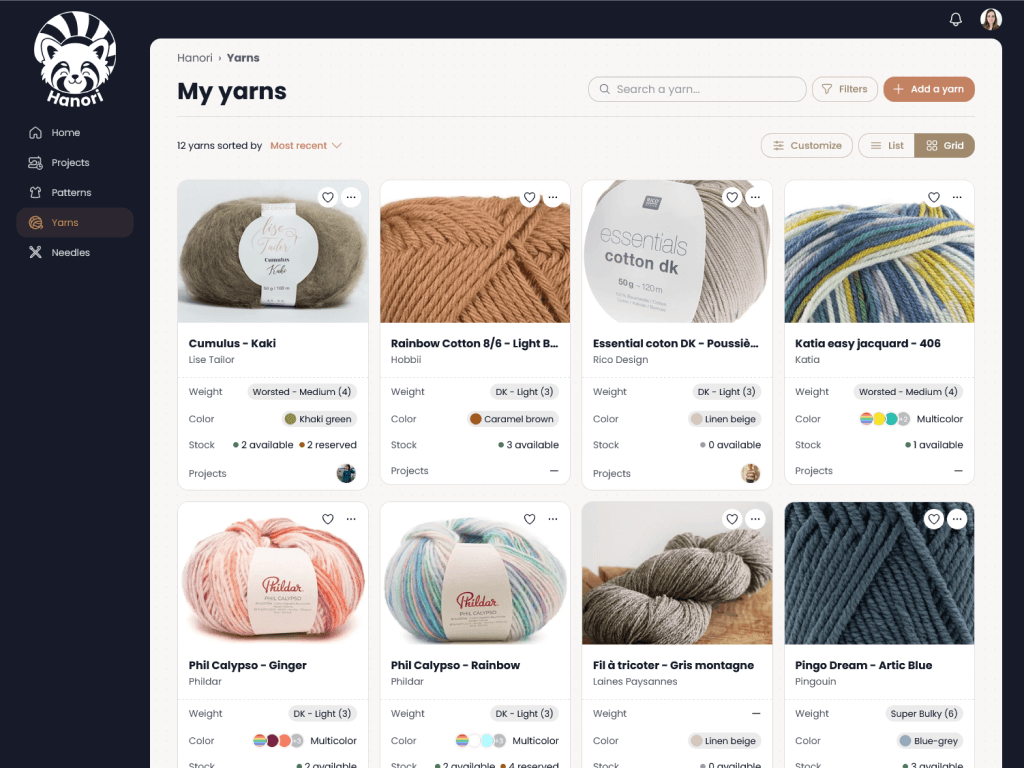
In Hanori, your yarn stash is free, with no limit on yarns. Each yarn has its own page, with everything from the list above, from fiber content to where it's stored.
Best of all, your stash keeps count by itself. When you add a yarn to a project in progress, its skeins are reserved. When the project is done or abandoned, Hanori asks what you actually used and updates your stash. You can see your total, reserved, available and used skeins at a glance.
Back from the yarn shop, the "Yarn" quick action on your Home page lets you add a new skein in seconds. And filters find "all my mohair yarns" for you when you're looking for something to start a project with. For the skeins forgotten at the bottom of a tub, Sleeping yarn (a Premium feature) suggests one every day on your Home page, with patterns from your library to wake it up.
Frequently asked questions
Should I write down the dye lot?
Yes. Two skeins of the same colorway from different dye lots can be a slightly different shade, and it shows once they're knitted or crocheted. Noting the dye lot lets you buy a matching skein, or know that your skeins don't all come from the same lot.
How do I know if I have enough yarn for a project?
Compare yardage rather than number of skeins: multiply your available skeins by the yardage of one skein, and compare that with the yardage the pattern asks for. Only count available skeins, not the ones already reserved for another project.
What should I do with yarn I'll never use?
Give it away or swap it: to a friend, a knitting group, a charity, or at a yarn swap. And before you part with it, check whether it could go into a small scrap yarn project.
Is there a free app to manage a yarn stash?
Yes. In Hanori, your yarn stash is free with no limit on yarns: one page per yarn, skeins reserved automatically by your projects, and a stash that updates at the end of each project. It's part of a complete knitting & crochet notebook that's free to start.
Your stash deserves better than a drawer and a good memory
A well-organized stash isn't a perfectly tidy one: it's one where you know what's inside. Once your inventory is done, it only takes two small habits, when you get back from the yarn shop and at the end of each project.
So, do you sort your yarn by color or by weight? Tell me on Instagram, @hanori.app 🧶